Once you’ve finished your novel, made your final story revisions, and decided on publication details like a cover and release date, your next step might be looking for a copy editor to polish the prose and correct grammatical issues.
Having a fresh set of eyes on your manuscript, especially those of a professional editor, is an excellent idea that can really elevate your novel’s writing. It’s very hard to objectively assess your own writing and catch all the issues, especially after you’ve re-read it dozens of times. That said, what can you do to help prepare your manuscript before sending it to a professional, and why should you put in the extra effort? Let’s find out.
What Does a Copy Editor Do?
A copy editor addresses the writing style, language, and grammar at a sentence and paragraph level. While a developmental editor, critique partner, or beta read will offer high-level suggestions for story and characters, a copy editor gets down and dirty with the prose. A copy editor might restructure sentences or paragraphs to make things flow better. They might edit word choice to provide better or more nuanced options. They might correct pervasive grammar issues like comma use or dialogue punctuation. Basically, they’ll do anything and everything to polish the writing into a clean, readable, and publishable form.
For some manuscripts, this might be only a small handful of changes per page in order to clean up a few remaining issues. For other manuscripts, this may mean a decent number of changes. Every author is unique, and every piece of writing will need individualized attention from a copy editor to make it shine.
Importance of Copy Editing
Whole books could be written on why it’s a good idea to have a copy editor for your work, but here’s a quick overview:
- It improves the quality of your writing. Copy editing can smooth your style, make your voice consistent, eliminate repetition, increase clarity, and provide a number of other improvements.
- It catches issues with the grammar, style, and punctuation that you may not have caught yourself.
- It can catch any last-minute continuity mistakes or minor plot holes.
- It adds a professional touch to your novel, increasing the chances that readers will stick with the story because it’s readable and error free.
6 Common Copy Edits I Make for Clients
While every author is unique, I personally find there are some common writing issues I address over and over again across multiple clients. I’ll go over a few of them below so that as you edit, you can keep them in mind. For each issue, I’ve provided examples that I see frequently (left column), the way I would correct them with my changes tracked (middle column), and the final result (right column).
1. Dialogue/Action Beat Punctuation
One of the most pervasive issues I see is with dialogue punctuation. Take a look at the examples below, and then I’ll go over them.
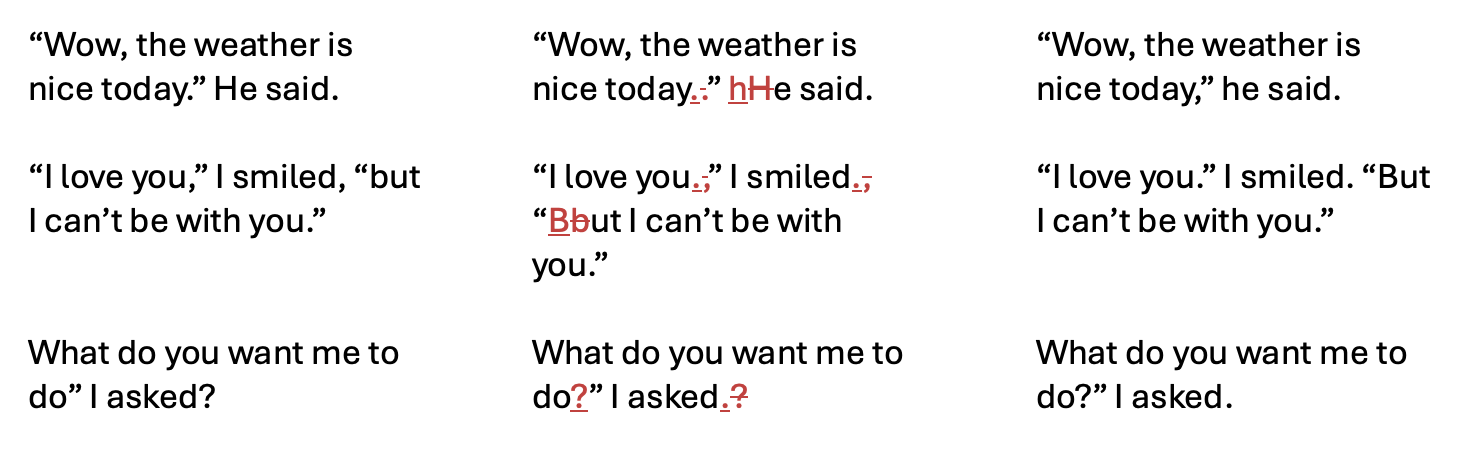
Example 1: To end a statement sentence before a dialogue tag, you use a comma, not a period. The tag itself is then lowercase, not capitalized.
Example 2: In this case, “I smiled” is actually an action beat, not a dialogue tag. Essentially, an action beat is a short description that comes before, during, or after dialogue, but one that isn’t describing how the words themselves are spoken or conveyed. Things like smiling, gesturing, nodding, and so on aren’t done directly with your voice, and therefore can’t be dialogue tags. Instead, we call them “action beats” and they are punctuated like normal sentences that aren’t part of the dialogue.
Example 3: Question marks always go with the sentence they are turning into a question, so in this case, the question mark goes inside the double quotes, and the dialogue tag is punctuated with a period.
2. Em Dash Errors
Another consistent issue I see is with how people use em dashes. Take a look at the examples below, and then I’ll go over them.
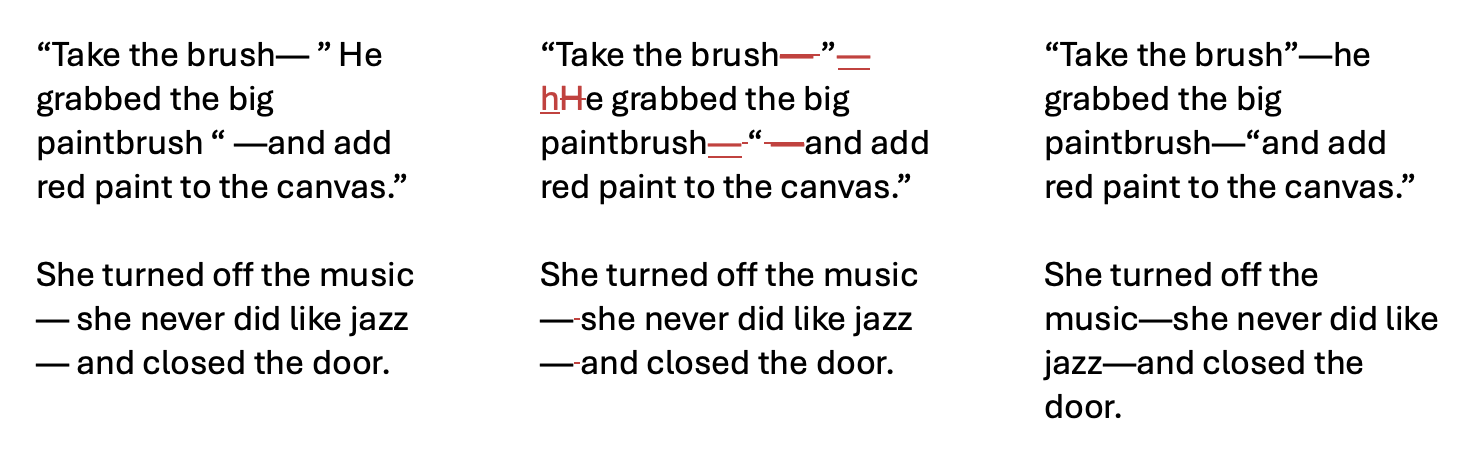
Example 1: Per The Chicago Manual of Style (CMOS), when you interrupt dialogue with em dashes, the em dashes actually go with the interrupted action, not with the speech inside the quotes.
Example 2: This one is hard to see in my example, but per CMOS, em dashes are used without spaces on either side of them.
3. Rogue Capitalization
A third common edit I make for clients is to hunt down and eliminate what I like to call “rogue capitalization.” This tends to be words that are capitalized in some instances but not others, and an author might not know the nuance of when to capitalize them. Take a look at the examples below, and then I’ll go over them.
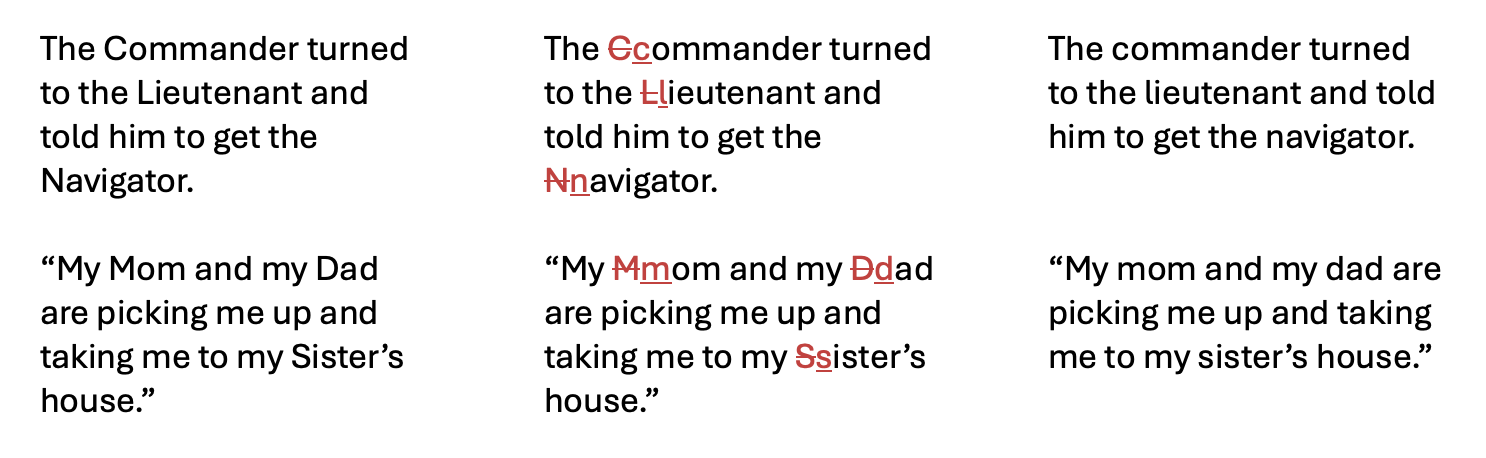
Example 1: Per CMOS, military titles are only capitalized in direct address (e.g., “Yes, Commander Smith!”). If you are simply speaking about the commander in general narration or dialogue (usually with an article like “the” or “a” in front of it), it’s lowercase.
Example 2: Similar to the first example, a person’s title or familial relationship is usually only capitalized in direct address. In other circumstances, you don’t capitalize the word.
4. Paragraph Breaks (Especially Surrounding Dialogue/Speakers)
A fourth problem I see is with how people break down their paragraphs, especially when there are a lot of actions and a lot of dialogue happening between two characters. Take a look at the example below, and then I’ll go over it.
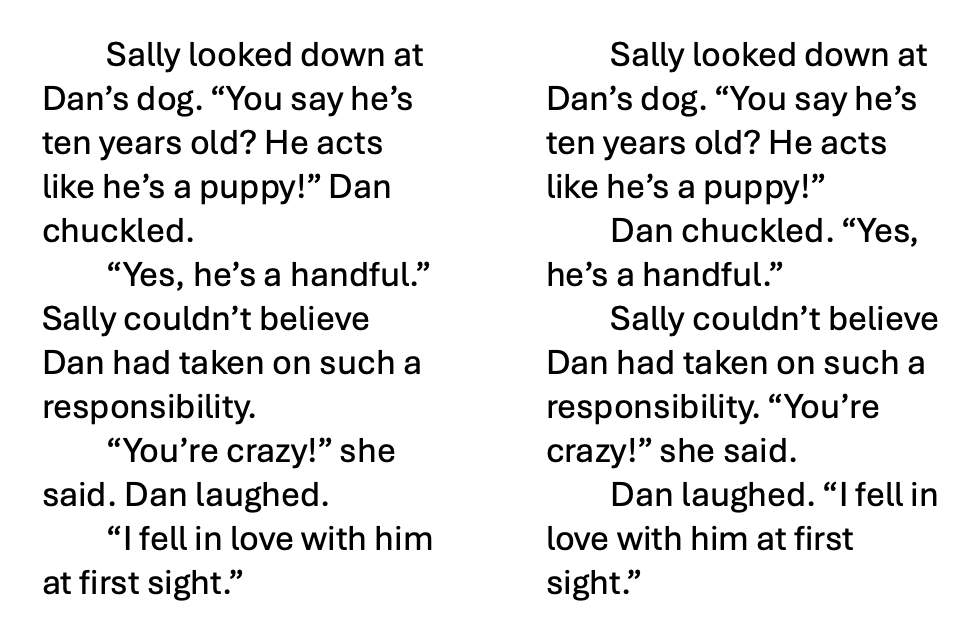
On the left, you’ll see that in every paragraph, Sally and Dan’s actions and dialogue are mixed. In the first paragraph, Sally speaks, but then Dan reacts. In the second paragraph, Dan speaks, then Sally reacts. In the third paragraph, Sally speaks and Dan reacts. In general, you want to put a character’s dialogue and actions together, then when a new character does/says something, you want a new paragraph break. On the right, you’ll see I’ve moved the paragraph breaks around so that the first paragraph is all Sally’s dialogue/actions, then second is all Dan, the third is all Sally again, and the fourth is all Dan.
5. Filtering
Another common issue I correct frequently is filtering. Filtering (or using filter words) is when the author adds words into the sentence that increase the distance between the reader and the action/emotion. Sometimes, you intentionally want this distance, but usually you don’t. It’s normally preferable to remove filter words unless you deliberately want that more “detached” feeling in the writing. Take a look at the example below.
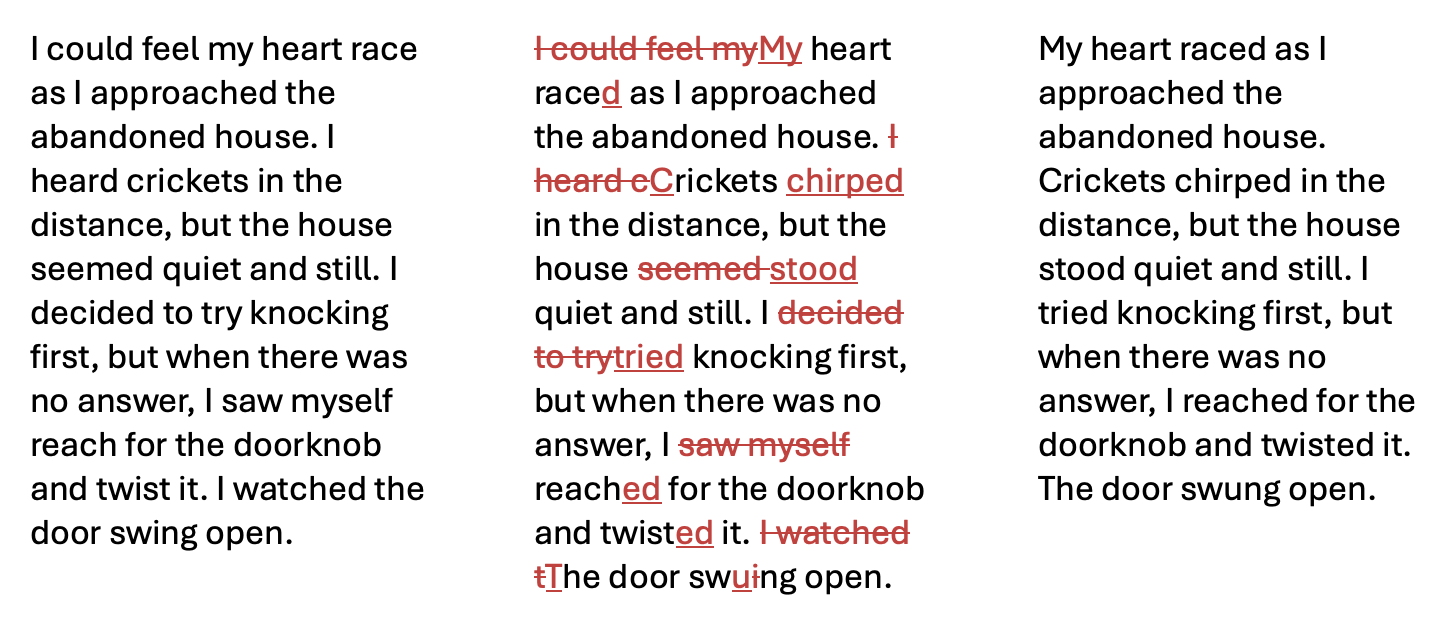
On the left, you can see a lot of filtering happening. That’s probably why there’s so much red in the middle column where I tracked the phrases I removed. On the right is a cleaner, punchier version of the original. You’ll see, too, that it’s often fairly easy to remove filter words without changing meaning or doing too much work!
6. Breaking Down Overly Long Sentences
Finally, a common issue I see is overly long sentences that are hard to read. These often aren’t wrong, per se, but they might be confusing to the reader or feel clunky. Take a look at the example below.
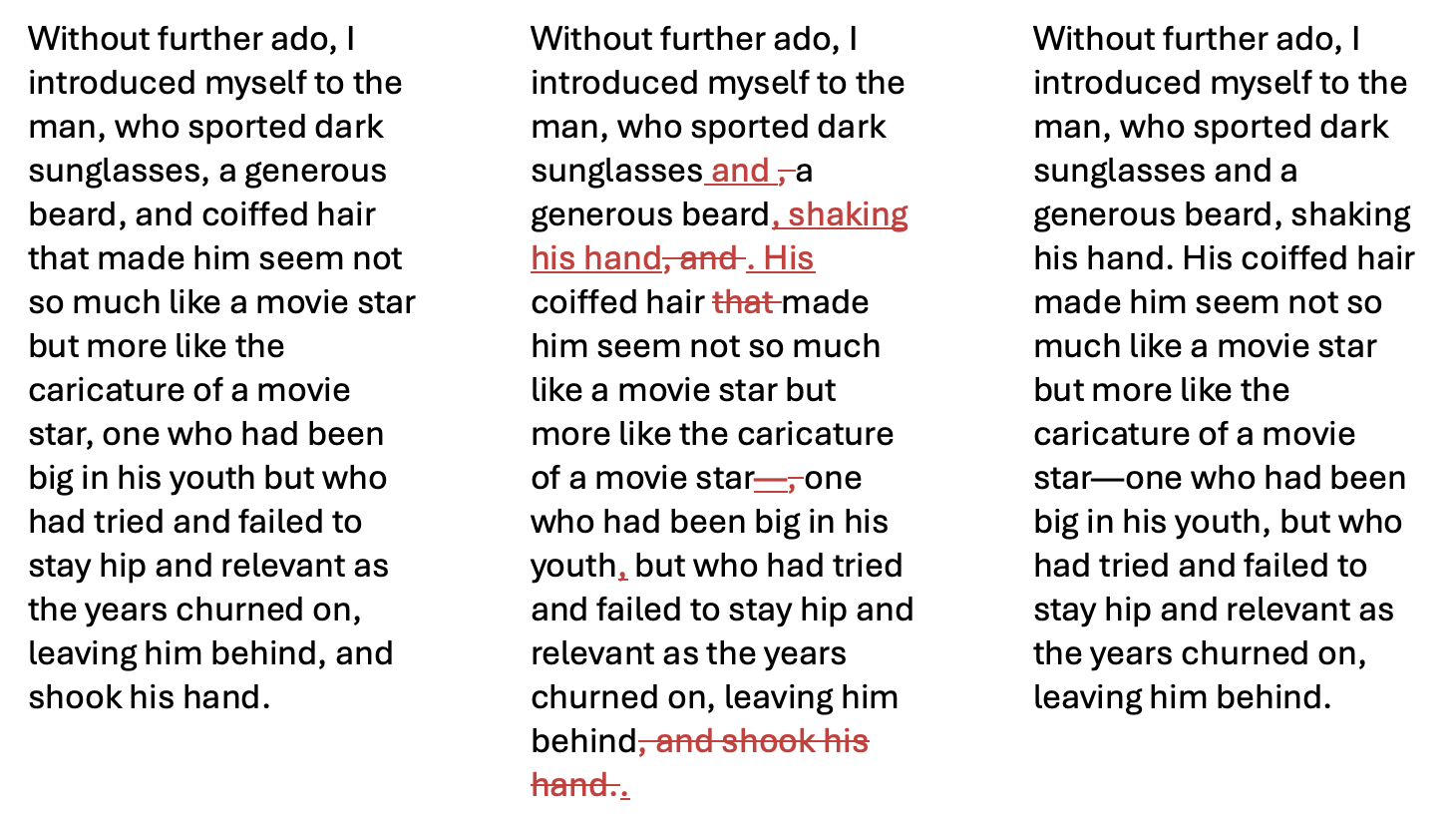
As noted, there’s nothing technically wrong with this sentence. That said, I don’t know about you, but I had to read it a few times to really get it. So if I see sentences like this, and the style of the novel also isn’t obviously intentionally going for this, I’ll break them down a bit in order to be more readable. Anything you can do to make things easier on the reader is better—you don’t want them tripping over sentences as they are eagerly reading your book and trying to turn to the next page!
Why It’s Good to Make It Easier on Your Editor
You might be thinking, “But if I hire a professional to copy edit my novel, why should I edit it myself first? Isn’t that like cleaning my house before the cleaners come?” And yes, it is tempting to simply leave the heavy lifting to the professional and get your money’s worth. That said, here are some reasons you may want to do as much editing as you can before sending it off for more work:
- The more work a copy editor needs to do, the higher the rate. Many editors charge per word, and they increase the per-word fee if the editing looks like it will be heavy. You can often reduce the cost of the edit by making the manuscript as clean as possible before giving it to your editor.
- The more changes a copy editor needs to make, the more likely it is that errors, mistakes, or awkward phrasing will be left behind. It isn’t a copy editor’s job to catch every single issue, although most will want to produce an extremely clean manuscript for their clients. That said, if entire paragraphs need to be rearranged and sentences need to be rewritten, there’s more of a chance of minor issues being introduced or missed during the edit.
- The fewer changes the editor needs to make, the more they can ensure that they are retaining your author voice. Most copy editors will strive to make their edits fit with your style and tone, but if the manuscript needs a lot of work, this can be hard to do. The fewer the edits, the more invisible they can be.
- If you make your names, places, capitalization, and spelling as consistent as possible, it reduces the number of inquiries the copy editor might have while working on your manuscript. Whereas if you spell a single character’s name as Katherine, Catherine, Katharine, and Cathryn throughout the novel, the copy editor needs to confer with you about the correct choice or attempt to make it themselves. Then they’ll need to make sure everything is documented on your style sheet in order to keep all the decisions straight.
Wrapping Up
Putting some effort into identifying and fixing common grammar mistakes before sending your manuscript out for a copy edit can not only help your editor out, but it can also be an excellent learning experience for improving your writing and style.